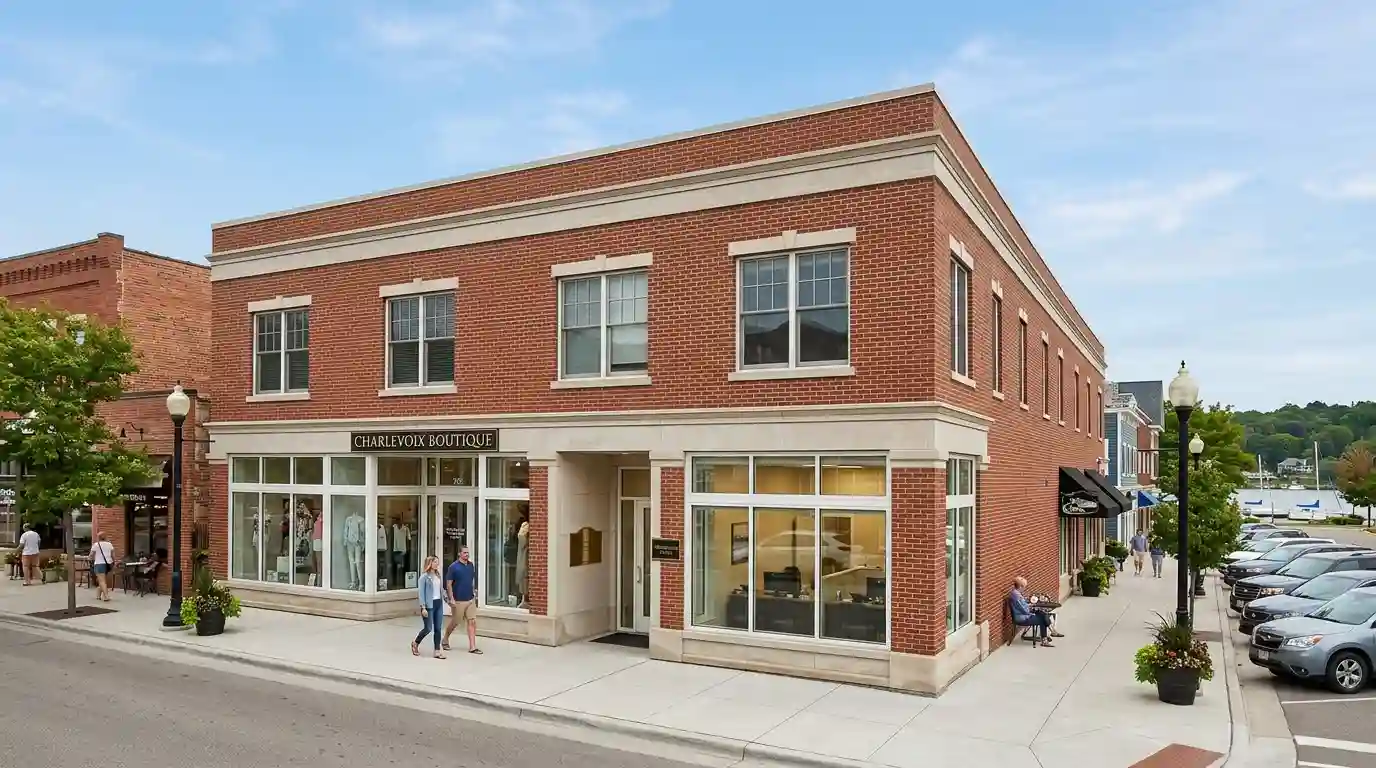
Charlevoix’s northern Michigan setting, established downtown, seasonal visitor activity, and year-round community create several possible commercial property opportunities. However, the suitability of any investment depends on the specific property, its location, permitted uses, and realistic income potential.
Understanding the Charlevoix Commercial Real Estate Market
Commercial property in Charlevoix can serve different purposes, from retail storefronts and professional offices to hospitality businesses, service facilities, and industrial spaces. Each property type has its own demand drivers, operating requirements, and financial risks.
Investors researching commercial real estate investment opportunities should begin by identifying the type of tenant or business most likely to use the property. A storefront that depends on pedestrian traffic will need a different location assessment from a warehouse that prioritizes vehicle access and storage capacity.
Local business activity can also influence property demand. For example, hospitality-related properties may depend partly on visitor spending, while professional offices and essential services may rely more heavily on residents and established businesses. Reviewing popular travel destinations and distinctive tourism destinations can offer general context on how visitor experiences shape travel-related businesses, although neither page provides Charlevoix-specific market data.
1. Choose the Right Commercial Property Type
Before comparing listings, decide which investment category matches your budget, experience, and preferred level of involvement.
Retail and Downtown Storefronts
Retail units may appeal to investors seeking tenants such as specialty shops, service providers, or food businesses. Visibility, parking, pedestrian access, neighbouring businesses, and the property’s permitted use can influence performance. A desirable downtown address does not automatically guarantee strong sales or reliable rental income.
Investors evaluating food-related tenants can consider the operational requirements of businesses such as the restaurant and dining sector, while remembering that this example is not a local Charlevoix market indicator.
Office and Professional Spaces
Office properties may suit professional services, administrative teams, healthcare providers, or other businesses requiring dedicated workspace. Review floor plans, accessibility, internet connectivity, parking, maintenance costs, and the likelihood that the space can accommodate different tenants in the future.
Consider whether the layout can be adapted without major structural work. Flexible spaces may be easier to reposition if a tenant leaves or business requirements change.
Hospitality and Visitor-Oriented Properties
Hotels, short-term visitor accommodation, and other hospitality-related assets may benefit from tourism demand, but seasonal revenue fluctuations can create cash-flow challenges. Assess occupancy assumptions, staffing, utilities, insurance, maintenance, and any required licences before making an offer.
Researching accommodation businesses such as hotel properties or destination hospitality operations can help illustrate different accommodation models, but investment assumptions must be based on Charlevoix-specific evidence.
Industrial, Storage, and Distribution Properties
Industrial properties may suit contractors, distributors, storage operators, and businesses that need practical access for deliveries. Evaluate loading facilities, ceiling height, vehicle access, utility capacity, environmental history, and zoning compatibility.
For broader operational context, review how logistics operations, shipping services, and transportation and brokerage models differ in their operational needs. These general business topics are not evidence of local industrial demand.
2. Evaluate Location Before the Building
Location affects customer access, tenant appeal, resale potential, and the property’s practical usefulness. Compare each candidate property against the needs of its likely occupants rather than relying on appearance alone.
- Visibility: Determine whether customers can easily identify the property from nearby roads or pedestrian routes.
- Accessibility: Assess entrances, parking, public access, delivery routes, and mobility requirements.
- Nearby businesses: Identify complementary services, competing businesses, and potential sources of customer traffic.
- Neighbourhood fit: Consider surrounding residential, commercial, recreational, and industrial uses.
- Future flexibility: Check whether the location and building could accommodate another permitted use if the current tenant leaves.
Investors can also review broader property-related considerations in real estate buying and selling, property market considerations, and property presentation and staging. These articles provide general context rather than comparable sales data for Charlevoix commercial properties.
3. Verify Zoning, Permitted Uses, and Development Restrictions
A property’s existing use does not necessarily mean that every future use is permitted. Before committing to a purchase, verify the applicable zoning district, permitted activities, building requirements, parking rules, signage restrictions, and any approvals needed for renovations or a change of use.
Contact the relevant Charlevoix planning and zoning office to confirm requirements for the specific parcel. If you are considering an addition, conversion, new construction, or mixed-use project, identify approval requirements and likely costs before finalising your budget.
Review building permits, fire and life-safety requirements, accessibility, utility connections, environmental concerns, and any applicable historic or design restrictions. Do not assume that a proposed business can operate simply because a similar business operates nearby.
4. Calculate the Full Cost of Ownership
A purchase price alone does not reveal whether a commercial property is a sound investment. Estimate the total acquisition cost and recurring expenses before deciding how much to offer.
Include the following items in your financial review:
- Purchase price, closing costs, legal fees, and inspections.
- Property taxes, insurance, utilities, and routine maintenance.
- Repairs, capital improvements, and contingency reserves.
- Management costs, leasing expenses, and periods without a tenant.
- Financing costs, interest-rate changes, and loan repayment obligations.
- Renovation expenses, permitting costs, and potential environmental remediation.
For a rental property, calculate net operating income by subtracting operating expenses from effective rental income before debt service and income taxes. Then compare the resulting income with the total investment and the returns available from alternative properties.
Investors considering financing should understand the risks of borrowing and repayment. General discussions such as financing options and financial planning can introduce relevant concepts, but actual commercial loan terms must be obtained from qualified lenders.
5. Research Tenants and Local Business Demand
Reliable tenants can make property ownership more predictable, but investors should evaluate the quality of the lease as carefully as the building. Review the tenant’s operating history, ability to pay rent, lease duration, renewal options, maintenance responsibilities, and any guarantees or security deposits.
When a property is vacant, estimate the time and cost required to attract a suitable tenant. Avoid assuming that a new occupant will sign immediately or accept the rent you have projected.
Think about the types of businesses that could realistically operate at the property. Home improvement and property maintenance companies, for instance, may have different space requirements from consumer-facing retailers. Related business topics such as building addition services, home service businesses, and digital services for home-service companies illustrate the variety of business models that can require commercial premises. Their presence does not establish local tenant demand.
6. Inspect the Property and Identify Hidden Risks
Arrange a professional inspection before the transaction becomes unconditional, where possible. The assessment should cover the roof, foundation, structure, electrical system, plumbing, heating and cooling, drainage, and visible signs of water damage.
Depending on the building’s history and intended use, you may also need environmental testing, a review of hazardous materials, fire-safety assessment, accessibility review, or specialist mechanical inspections. Check for outstanding permits, unresolved code violations, easements, title issues, and restrictions that could affect future use.
If renovations are necessary, obtain written estimates and build a realistic contingency into the budget. Projects involving a commercial addition or conversion may require design work, contractors, approvals, and extended periods when the property cannot generate income.
7. Compare Properties Using a Consistent Checklist
To save time, use the same evaluation criteria for every candidate property. This prevents an attractive feature from distracting you from a serious financial or legal weakness.
| Evaluation area | Questions to answer |
|---|---|
| Location | Can the intended tenant reach customers, suppliers, and employees conveniently? |
| Zoning | Is the proposed use permitted, and are additional approvals needed? |
| Financials | Are rental assumptions, expenses, financing, and reserves realistic? |
| Condition | What repairs or capital improvements are required? |
| Tenancy | Is there a reliable tenant, or is vacancy risk significant? |
| Exit strategy | Could the property be leased, sold, or adapted if circumstances change? |
Compare the results before arranging repeated site visits or making an offer. A simple scoring sheet can help you eliminate unsuitable options early and focus on properties that meet your core requirements.
8. Build a Practical Due Diligence Team
Commercial acquisitions often involve several specialised areas. Depending on the transaction, seek advice from a commercial real estate broker, real estate attorney, accountant, lender, building inspector, insurance professional, and environmental consultant.
Each professional should answer a defined question. The broker can help assess comparable properties and leasing conditions; the attorney can review contracts and title matters; the accountant can assess financial assumptions; and technical specialists can identify physical or environmental risks.
Clarify fees, deliverables, deadlines, and any conflicts of interest before engaging advisers. Coordinating these reviews early can prevent delays and reduce the chance of discovering a major issue near closing.
9. Create an Investment Plan With Multiple Scenarios
Prepare conservative, expected, and optimistic projections rather than relying on a single forecast. Test how the investment would perform if rent were lower than anticipated, repairs cost more than expected, interest rates changed, or the property remained vacant longer than planned.
Set clear conditions for proceeding, renegotiating, or walking away. These might include a minimum expected return, a maximum renovation budget, acceptable financing terms, satisfactory inspection results, and confirmation that the intended use is permitted.
Investors should also define their exit strategy. A property intended for long-term rental income may require a different tenant mix and maintenance plan from one purchased for renovation and resale. Your strategy should reflect your financial capacity, experience, and tolerance for risk.
Final Thoughts
Charlevoix commercial real estate can offer opportunities for investors who approach each property with careful research and realistic financial expectations. The most effective way to save time is to define your investment criteria, verify permitted uses early, compare total ownership costs, assess tenant demand, and complete thorough due diligence before committing capital.
Rather than choosing a property solely because it looks promising, evaluate whether its location, condition, income potential, and flexibility support your investment plan. A disciplined process can help you identify better-fit opportunities, avoid preventable expenses, and make more informed commercial property decisions.