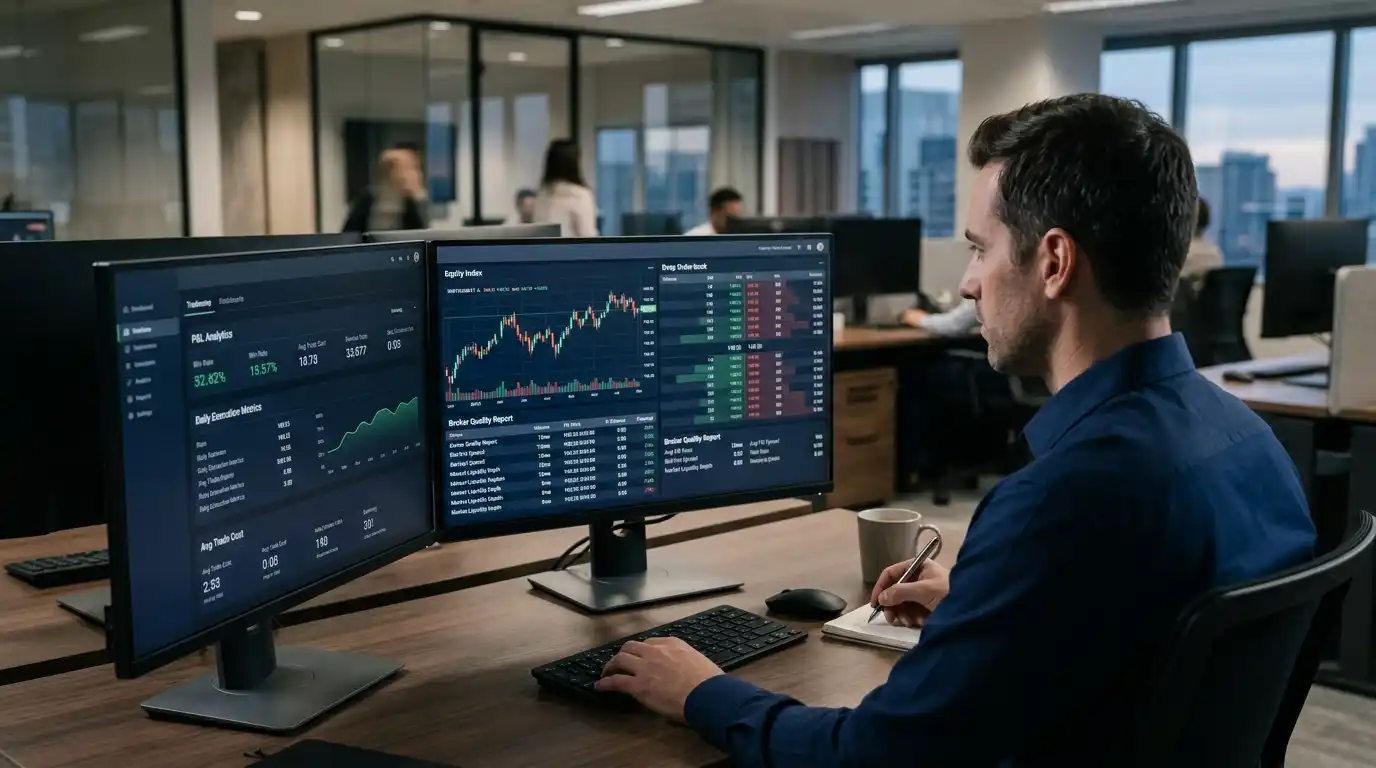
A broker cannot eliminate market risk or guarantee profits. However, a carefully evaluated broker can help traders understand execution conditions, avoid unnecessary operational risks, and make more informed decisions about where to hold and deploy trading capital.
Why Broker Selection Matters for Active Traders
Every trading strategy depends on a series of operational decisions. Orders must reach the broker, be processed according to its execution model, and receive a fill under the available market conditions. Delays, rejected orders, unexpected spreads, and platform interruptions can affect the final result.
Traders evaluating market liquidity and execution quality should look beyond advertised performance claims. The relevant question is whether a broker’s actual service matches the instruments, trading frequency, order sizes, and risk limits of the strategy.
This is also why a broker should be assessed as part of the wider trading process rather than as a separate administrative choice. A strategy that relies on rapid decisions needs different operational support from one that holds positions for weeks or months.
1. Verify Regulation and the Exact Legal Entity
Regulatory status should be one of the first checks. Identify the full legal name of the company that will hold your account, the regulator responsible for supervising it, its authorization status, and the jurisdiction stated in the client agreement. Verify those details directly through the regulator’s official register rather than relying solely on a broker’s logo or marketing statements.
Broker brands may operate through different legal entities in different countries. The protections available to one client may not apply to another client using the same brand. Check the rules that apply to your specific account, including complaint procedures, eligible compensation arrangements, and restrictions on the products offered.
Regulation does not guarantee that a firm will never fail or that every trade will be profitable. It is one part of a broader due-diligence process that also includes financial transparency, operational reliability, and the treatment of client funds.
2. Understand How Client Funds Are Protected
Capital safety starts with understanding where deposited money is held and what happens if the broker becomes insolvent. Review the broker’s client-money policy, segregation arrangements where applicable, withdrawal terms, and the circumstances in which funds may be used or transferred.
Ask whether negative-balance protection or an investor compensation scheme applies to your account, and confirm any eligibility limits or exclusions. These protections vary by jurisdiction, account type, and financial product, so do not assume they apply automatically.
Strong account security matters as well. Look for multi-factor authentication, account activity notifications, secure withdrawal procedures, and clear processes for reporting suspicious access. Keep your own devices, passwords, and recovery details protected.
3. Evaluate Liquidity Access and Market Depth
Liquidity describes how readily an asset can be traded without causing a substantial change in price. A liquid market generally offers more opportunities to execute orders near available quoted prices, while thin markets can have wider spreads, less depth, and greater price impact.
For frequent traders, liquidity access matters because a quote alone does not show how much can be traded at that price. Review the instruments available, typical spreads during your trading sessions, order-size limits, and the broker’s explanation of its execution arrangements.
For foreign exchange and contracts for difference, ask how orders are handled and whether the firm acts as principal, routes orders to external venues, or uses a combination of approaches. Labels such as ECN, STP, or direct market access should not replace a review of the actual terms and execution disclosures.
Traders researching cryptocurrency and investment-market exposure should remember that liquidity varies significantly across assets and trading venues. A broker offering a large list of instruments does not necessarily provide equally strong liquidity for all of them.
4. Measure Execution Speed and Reliability
Execution speed is the time between submitting an order and receiving a meaningful execution response. It matters most when the strategy depends on small price movements, frequent transactions, or time-sensitive market conditions. Yet speed should never be considered in isolation from price quality and order-handling reliability.
Evaluate order acknowledgement times, fill rates, rejected orders, partial fills, requotes where applicable, and platform interruptions. If the broker publishes execution statistics, examine how they were calculated and whether they describe conditions comparable to your own trading activity.
High-frequency trading can involve specialized infrastructure, direct connectivity, market-data feeds, and venue-specific requirements. A standard retail account should not be assumed to support institutional high-frequency trading simply because a broker advertises fast execution. Confirm whether your intended order rate, automation, and strategy are permitted under the account terms.
Where possible, compare execution records across normal sessions and more volatile periods. Record the order time, requested price, fill price, spread, slippage, and any rejection. This creates evidence you can evaluate instead of relying on general marketing claims.
5. Compare Total Trading Costs
A low advertised spread is not the same as a low total trading cost. Depending on the product and account, charges may include spreads, commissions, financing or swap fees, currency conversion, market-data subscriptions, platform charges, and deposit or withdrawal fees.
For frequent trading, even a small difference per transaction can become material after many orders. Compare brokers using the same instrument, approximate trade size, holding period, and trading session. Include both explicit fees and the effect of slippage.
For example, a broker with a slightly wider spread may still be more economical if it offers more consistent fills and lower commissions. The only meaningful comparison is based on the costs and conditions relevant to your actual strategy.
When reviewing specialist financial products, articles such as penny stocks and cryptocurrency risk and digital and physical asset exposure can provide additional context about why product characteristics should be considered separately from broker fees.
6. Check Platform Stability and Technology
A reliable trading platform should remain responsive, display accurate account information, and handle the order types your strategy requires. Review available desktop, web, and mobile options, along with charting, reporting, alerts, and application programming interfaces if you use automated trading.
Technical reliability also depends on the wider setup. Internet connectivity, computer performance, software updates, market-data delivery, and backup access can all affect your ability to manage positions. Traders running demanding applications should understand the hardware requirements and avoid unnecessary background workloads during critical sessions.
For related technology considerations, see the risks of outdated software, AI and cybersecurity, and mobile productivity applications. These topics are relevant to maintaining a secure, organized technology environment, although they do not independently establish a broker’s execution quality.
Traders using digital-asset platforms may also want to understand the product and platform details discussed in cryptocurrency trading platforms and cryptocurrency monitoring tools. Always verify current availability, legal status, and service conditions before relying on a particular platform or feature.
7. Test the Broker Before Committing Significant Capital
A structured trial can reveal problems that are difficult to spot on a promotional page. Start with a demo account to learn the platform, test order types, and check whether the available instruments match your strategy. Remember that simulated execution may differ from live-market conditions.
Before funding an account, ask customer support specific questions about execution, fees, withdrawals, margin rules, and restrictions on automated strategies. Save the answers and compare them with the written terms.
If the broker passes your initial checks and you decide to proceed, consider beginning with an amount appropriate to your financial circumstances rather than committing substantial capital immediately. Where practical, test the deposit and withdrawal process early. Never risk money you cannot afford to lose merely to test a service.
8. Review Margin, Leverage, and Liquidation Rules
Leverage allows a trader to control a larger position than the cash committed to it. This can magnify both gains and losses, and a relatively small market movement may have a significant effect on account equity.
Understand initial and maintenance margin requirements, margin-call procedures, liquidation thresholds, overnight financing, and the broker’s rights during volatile conditions. Check whether margin requirements can change and how the firm communicates those changes.
Do not select a broker simply because it offers the highest leverage. A suitable account is one whose risk controls, product terms, and margin rules you understand and can manage. A broker’s liquidation policy can be especially important when prices gap or liquidity declines.
9. Identify Warning Signs Before Opening an Account
Be cautious of guaranteed-profit claims, unexplained bonuses, pressure to deposit quickly, unclear legal information, and promises of perfect execution. Other warning signs include inconsistent company details, repeated unexplained withdrawal delays, vague fee schedules, and refusal to explain the execution model.
Check independent complaints for repeated patterns rather than treating one review as proof. Distinguish between a market loss and a genuine operational complaint, and look for clear evidence before drawing conclusions about a company.
Financial products also differ substantially in risk. Readers exploring financial technology, financial services, or flash-loan concepts should evaluate each product on its own terms and avoid assuming that information about one service proves the reliability of another.
10. Match the Broker to Your Trading Strategy
There is no single broker that is best for every trader. A long-term investor may prioritize product access, custody arrangements, and account fees. An intraday trader may focus more on execution consistency, spreads, platform stability, and session-specific liquidity. An automated trader may need API documentation, predictable order handling, and explicit permission to use trading software.
Before making a decision, write down the strategy’s requirements: instruments, average order size, order frequency, trading hours, order types, acceptable costs, and maximum tolerable operational downtime. Use the same criteria for every broker on your shortlist.
Broader financial planning can also matter when deciding how much capital to expose to active trading. Consider the general principles covered in financial planning and borrowing and financial service arrangements, while remembering that borrowing to trade can increase financial risk rather than improve broker reliability.
Broker Evaluation Checklist
- Verify the broker’s exact legal entity and regulatory authorization.
- Understand client-fund arrangements and the protections that apply to your account.
- Compare total costs, including spreads, commissions, financing, and slippage.
- Assess execution quality using comparable and documented tests.
- Confirm liquidity, instruments, order types, and trading-style permissions.
- Check platform stability, account security, and customer support.
- Read margin, liquidation, withdrawal, and complaint-handling terms.
- Test the service carefully before committing substantial capital.
Conclusion
Choosing a reliable broker requires evidence, not promises. Regulatory verification and capital-protection arrangements should come first, followed by transparent costs, execution quality, liquidity, platform reliability, and suitability for your trading strategy.
For active and high-frequency traders, the best evaluation is based on measurable performance under relevant conditions. No broker can guarantee uninterrupted access, perfect fills, or trading profits. A disciplined selection process can, however, help you identify avoidable risks and make a more informed decision about the infrastructure supporting your trades.