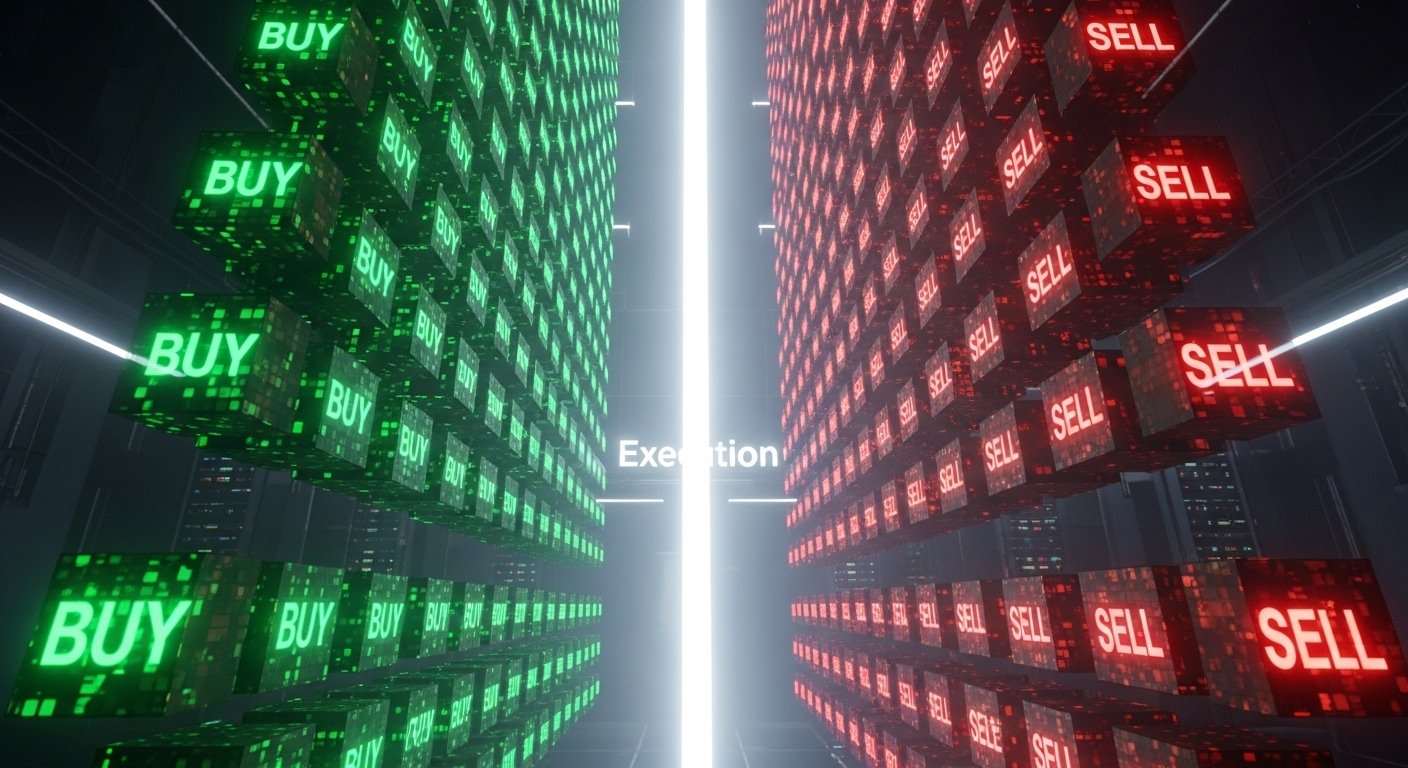
The vast majority of retail trading strategies focus almost exclusively on price action patterns, ignoring the fundamental fuel that drives price movement: liquidity. In professional market making, price is merely an advertisement, while liquidity represents the actual inventory available to be transacted at that price. For a trader to transition from gambling to professional asset management, they must understand the limit order book and the unseen mechanics of order flow. Without this understanding, technical analysis is simply an exercise in drawing lines on a chart without understanding the terrain beneath it.
Liquidity is not a static concept; it is a dynamic state that fluctuates based on time of session, macroeconomic releases, and the risk appetite of Tier-1 banks. When retail traders experience “stop hunts” or unexplained wicks, they are often witnessing a liquidity vacuum where orders are matched at the next available price, regardless of the chart’s visual continuity. Therefore, the ability to read market depth is a defensive skill set required to protect capital from predatory market algorithms. This article dissects the anatomy of the order book and the technological requirements for accessing true market depth.
The Anatomy of the Limit Order Book (LOB)
The Limit Order Book is the central nervous system of any exchange or electronic communication network (ECN). It displays the real-time list of buy and sell orders organized by price level, effectively showing the “depth” of the market at any given second. On one side, there are passive liquidity providers placing limit orders waiting to be filled, and on the other, aggressive market orders consuming that liquidity. The interaction between these two forces is what causes price discovery and volatility.
For retail traders, the danger lies in “thin” markets where the order book lacks density. In these scenarios, a relatively small market order can sweep through multiple price levels, causing significant slippage and pushing price into stop-loss clusters. Professional traders avoid these environments by analyzing Level 2 data to ensure there is sufficient counter-party interest to exit a position without distorting the price. Accessing this level of transparency is impossible without a direct market access environment.
The Impact of Latency on Order Matching
In the microstructure of financial markets, time is measured in microseconds, and speed is the primary determinant of profitability for short-term strategies. Latency refers to the delay between the signal generation on the client’s terminal and the order confirmation from the exchange’s matching engine. High latency creates a discrepancy between the price seen on the screen and the price actually secured, a phenomenon known as “stale pricing.”
Institutional firms invest millions in co-locating their servers next to exchange data centers to shave nanoseconds off their execution time. For the retail sector, while co-location is rare, the routing efficiency of the broker is paramount. If a broker routes orders through multiple intermediaries or “bridges,” the added latency guarantees negative slippage over a large sample size of trades. This friction is a hidden tax that often exceeds the cost of commissions or spreads.
Evaluating Brokerage Infrastructure and Connectivity
The bridge between a trader’s strategy and the interbank market is the brokerage infrastructure. A robust trading setup is meaningless if the gateway to the market—the broker—is prone to disconnects, artificial delays, or re-quotes during high volatility. Genuine market access requires a technology stack that aggregates multiple liquidity providers to ensure competitive pricing and execution resilience.
This brings the focus back to the due diligence required before funding an account. The technical specifications of a platform are often buried in legal documents, yet they dictate the statistical probability of success. Consequently, the rigorous process of how traders choose a reliable broker is the single most critical step in establishing a professional trading operation. Without vetting the broker’s connectivity and execution policy, a trader is essentially building a house on quicksand.
Slippage: The Silent P&L Killer
Slippage occurs when an order is filled at a different price than requested, and it is a direct function of volatility and liquidity depth. While positive slippage (getting a better price) exists, negative slippage is far more common in fragmented retail environments. This usually happens when a broker cannot find a matching order at the requested price due to a lack of liquidity providers in their aggregation pool.
To mitigate this, traders must differentiate between “market execution” and “instant execution” protocols. Market execution guarantees entry but not price, while instant execution guarantees price but not entry (leading to re-quotes). Understanding which protocol serves your strategy best is a key component of risk management. A transparent environment minimizes slippage by routing orders to the deepest liquidity pools available, rather than internalizing the risk.
“In the realm of high-frequency finance, the cost of execution is often higher than the cost of analysis; ensure your infrastructure is an asset, not a liability.”
Automated Trading and API Integration
The rise of algorithmic trading has shifted the focus from manual clicking to automated execution via Application Programming Interfaces (APIs). Algorithms require stable, uninterrupted connections to the broker’s server to function correctly, as even a momentary disconnect can leave a position unmanaged. This necessitates a Virtual Private Server (VPS) environment and a broker that supports FIX API or robust MT4/MT5 bridge solutions.
Traders utilizing bots or Expert Advisors (EAs) place a significantly higher load on the broker’s servers compared to manual traders. If the broker’s infrastructure is outdated, it will throttle the data feed or delay order processing, rendering the algorithm’s back-tested edge useless in the live market. Therefore, the scalability of the broker’s technology is a prerequisite for any automated strategy.
Visual Checklist: Signs of “Phantom” Liquidity
Not all liquidity displayed on a chart is accessible; “phantom” liquidity refers to orders placed to create the illusion of depth, only to be cancelled milliseconds before execution (spoofing). Recognizing the signs of a poor liquidity environment is essential for trade timing. The following indicators suggest a compromised execution environment.
- Widening Spreads During Calm Markets: If spreads expand significantly without any news catalyst, it indicates the broker has lost connection to primary liquidity providers.
- Frequent Re-quotes: Constant rejection of orders suggests the broker is hesitating to accept the risk or cannot match the price in the real market.
- Gapping on Lower Timeframes: Frequent price gaps on 1-minute or 5-minute charts indicate a lack of continuous order flow and thin order books.
- Frozen Data Feeds: Any pause in the price feed, usually followed by a fast-forward jump, is a sign of server overload or poor data aggregation.
Future Trends in Liquidity Provision
The future of liquidity provision lies in the decentralization of order books and the integration of blockchain technology for settlement. We are moving toward a hybrid model where the transparency of on-chain transactions meets the speed of centralized matching engines. This evolution will likely eliminate many of the opacity issues currently plaguing the retail brokerage industry.
Until fully decentralized institutional execution becomes the norm, traders must rely on rigorous selection criteria to partner with intermediaries. The convergence of AI-driven routing and deeper liquidity pools will continue to raise the bar. Those who prioritize infrastructure and execution quality today will be the ones best positioned to capitalize on the automated markets of tomorrow.