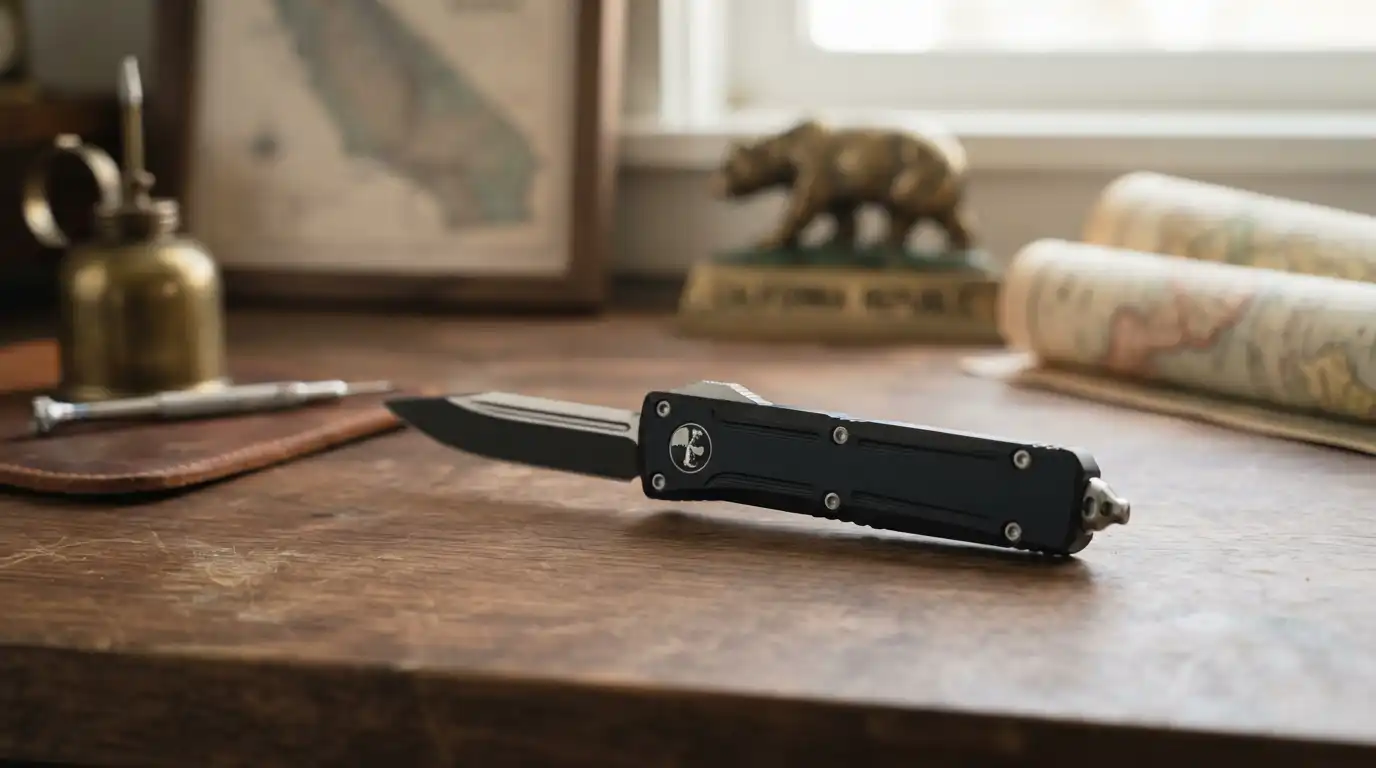
The important point is that California law does not treat every knife in exactly the same way. The legality of an OTF knife can depend on its blade length, design, how it is carried, where it is taken, and the circumstances surrounding possession or use. This guide explains the key concepts in plain language so readers can better understand California’s knife laws before buying, carrying, transporting, or collecting an OTF knife.
Important: Knife laws can change, and local restrictions may also apply. This article is intended as general educational information rather than individualized legal advice.
What Is an OTF Knife?
OTF stands for out-the-front. Unlike a traditional folding knife that opens from the side, an OTF knife uses a mechanism that moves the blade forward through an opening in the front of the handle.
OTF knives are commonly discussed in two broad categories: automatic OTF designs and manually operated OTF designs. The distinction can matter legally because California’s rules concerning switchblades and automatic knives focus on particular characteristics and measurements.
For collectors, understanding the mechanism is therefore only the first step. The exact configuration of a knife should be considered alongside California’s statutory definitions and restrictions.
Are OTF Knives Legal in California?
The short answer is that some OTF knives may be lawful in California, while others can fall within restrictions on switchblades or automatic knives. It is not accurate to assume that every OTF knife is automatically legal or automatically illegal.
California Penal Code provisions define a switchblade using specific characteristics, including how the blade is released and the length of the blade. The law also contains separate restrictions concerning possession, sale, transportation, and other conduct involving certain switchblades.
That means enthusiasts should examine the actual knife rather than relying solely on the label used by a manufacturer or seller. A knife marketed as an “OTF,” “automatic,” or “tactical” product should still be evaluated according to the applicable California legal definitions.
Understanding California’s Switchblade Definition
One of the most important concepts for an OTF collector is California’s statutory definition of a switchblade. The definition focuses on knives that have a blade that can be released automatically by a button, pressure on the handle, or another mechanism, subject to the conditions established by California law.
Blade length is particularly important. California’s switchblade provisions distinguish knives based on blade length, so collectors should measure the blade according to the applicable legal definition rather than relying on a product listing’s general description.
This distinction is one reason why statements such as “all OTF knives are illegal in California” can be misleading. The legal analysis depends on the knife’s characteristics and the specific conduct involved.
Blade Length Matters
When researching California legal OTF knives, blade length should be one of the first specifications checked.
A product page may describe a knife as compact, EDC-sized, or California-friendly, but those marketing descriptions do not replace the legal definition. Collectors should identify the actual blade length and compare the complete design with the applicable California rules.
It is also important to distinguish blade length from the overall length of the knife. A handle can be relatively large or small without changing the measurement that a particular statute uses.
Automatic Opening vs. Manual Opening
Another important distinction is whether the blade opens automatically or requires manual movement.
An automatic OTF knife uses a mechanism that propels the blade when an activation control is operated. A manual OTF design, by contrast, requires the user to manually move the blade through its mechanism.
Because California law specifically addresses switchblades and automatic opening mechanisms, collectors should not assume that two knives with similar external appearances have identical legal treatment.
Carrying an OTF Knife in California
Possession and carrying are not necessarily the same legal question. Even when a particular knife is lawful to possess, the circumstances in which it is carried can create additional issues.
Collectors should consider factors such as the location, the manner of carry, the knife’s configuration, and whether another California statute applies to the particular situation.
Public places can also have their own restrictions. Schools, government facilities, airports, courthouses, and other sensitive locations may be subject to additional laws or regulations affecting knives and other objects.
OTF Knives and Restricted Locations
A common mistake is to treat general knife legality as permission to carry the same knife everywhere.
California contains location-specific restrictions, and federal, state, or local rules can apply depending on where a person is traveling or entering. Airports and secure government facilities are particularly important examples because security rules may prohibit or restrict knives regardless of whether the item is otherwise lawful to possess.
For this reason, an enthusiast traveling with a knife should research the destination and transportation rules before leaving home rather than making assumptions based only on the knife’s blade length.
Buying California Legal OTF Knives
When evaluating an OTF knife for collection purposes, buyers should document the specifications before purchasing it. Useful information includes the blade length, opening mechanism, locking system, overall design, and manufacturer specifications.
A responsible buyer should also verify whether the seller actually ships the specific model to California. A seller’s shipping policy is not itself a legal determination, but it can signal that additional research may be necessary.
Collectors should be particularly cautious about vague product descriptions. Terms such as “California compliant” should not be treated as a substitute for examining the actual specifications of the knife.
How Collectors Can Document Their Knives
Keeping accurate records can make a collection easier to manage. A simple collector record can include the manufacturer, model, blade length, mechanism type, purchase date, and original product documentation.
Photographs and receipts can also help establish what a particular knife looked like and what specifications were represented at the time of purchase.
This approach is useful for serious collectors because knife designs can change between production runs. A model name alone does not always provide enough information to identify every variation.
California OTF Knife Laws vs. General Knife Laws
California knife law is broader than OTF knives alone. Different rules can apply to folding knives, fixed-blade knives, switchblades, dirks, daggers, and other designs.
Therefore, an enthusiast should avoid applying one rule to every knife in a collection. The mechanism, blade configuration, method of carry, location, and circumstances can all affect the legal analysis.
This is especially important for collectors who own several different knife types. A knife that is treated one way under California law may not have the same treatment as another knife with a similar appearance.
Common Misconceptions About California OTF Knives
Myth 1: Every OTF knife is illegal
Not necessarily. The legal treatment depends on the knife’s characteristics and the applicable statutory definitions.
Myth 2: Blade length is the only thing that matters
Blade length can be important, but it is not necessarily the only factor. The opening mechanism, knife design, location, and circumstances may also matter.
Myth 3: If a website ships it to California, it must be legal
A retailer’s shipping policy does not establish the complete legal status of a knife. Buyers remain responsible for understanding the laws that apply to their situation.
Myth 4: A knife legal at home is legal everywhere
Different locations can have additional restrictions. A collector should verify the rules before taking a knife into a sensitive or restricted location.
Safe and Responsible OTF Knife Ownership
Responsible ownership begins with understanding the law and treating the knife as a potentially dangerous tool. Collectors should store knives securely, keep them away from unauthorized users, and follow applicable transportation and location restrictions.
When displaying a collection, secure storage can reduce the risk of accidental access. Collectors should also preserve manufacturer documentation so that each item can be identified accurately.
For anyone uncertain about the legal status of a particular knife, consulting a California attorney who handles weapons or knife-law matters is the most appropriate way to obtain advice tailored to the specific circumstances.
California OTF Knife Collector Checklist
- Identify whether the knife opens automatically or manually.
- Measure and record the blade according to the applicable legal definition.
- Document the manufacturer and exact model.
- Check whether the knife falls within California’s switchblade definition.
- Review restrictions that may apply to the intended location.
- Check transportation and travel rules before carrying the knife elsewhere.
- Keep purchase records and product specifications.
- Store the knife securely when it is not being handled.
- Seek professional legal advice when the situation is unclear.
Final Thoughts on California Legal OTF Knives
California OTF knife law requires more than a simple legal-or-illegal label. The knife’s opening mechanism, blade characteristics, location, and circumstances can all be relevant.
For enthusiasts and collectors, the safest approach is to identify the exact specifications of each knife, understand the applicable California rules, and avoid relying solely on marketing descriptions or informal internet claims.
Because laws can change and individual circumstances can produce different legal questions, anyone making an important decision about possession or carrying should verify the current rules and obtain qualified legal advice when necessary.