This guide explains common flash-loan problems, practical diagnostic steps, security precautions, and ways to investigate transaction failures without exposing your wallet or funds to unnecessary risk.
What Is an Equalizer Finance Flash Loan?
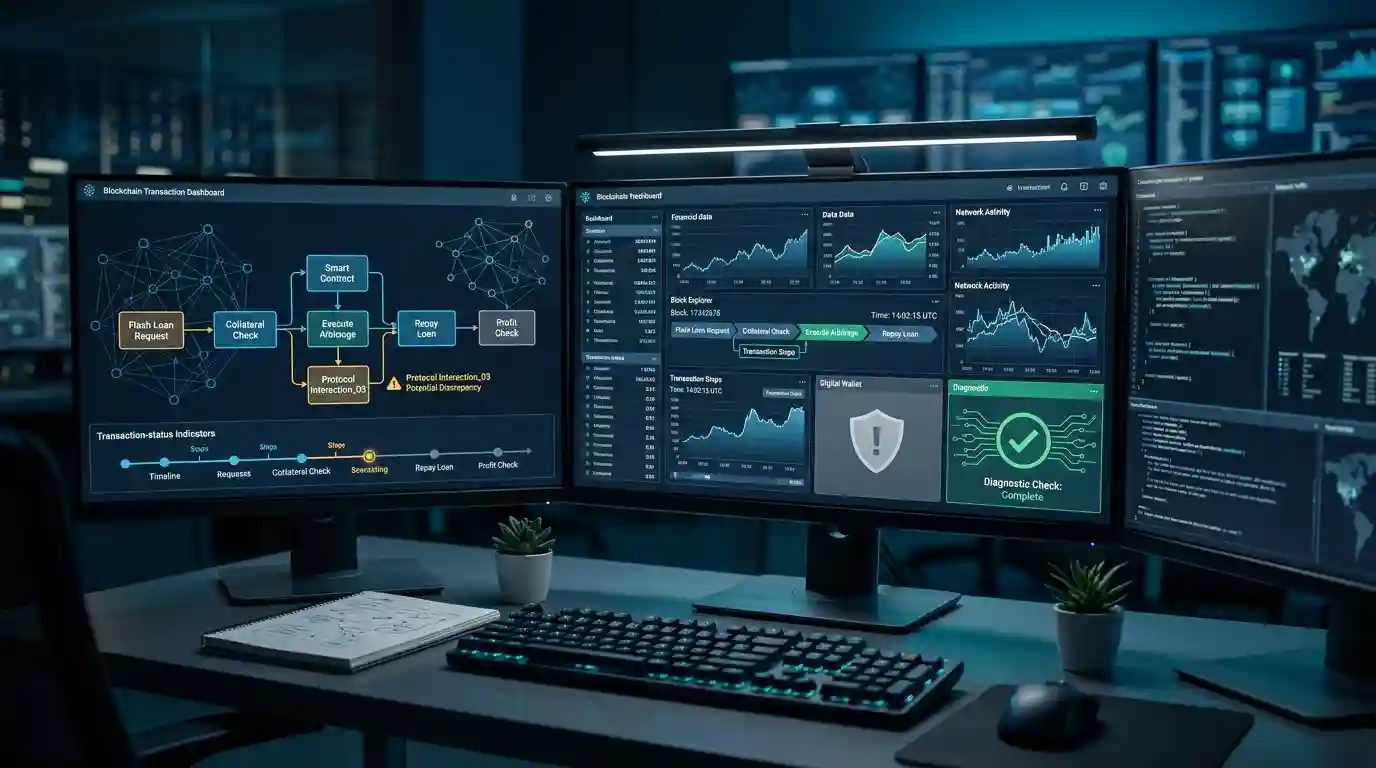
A flash loan is a transaction-based borrowing arrangement used in some DeFi protocols. Instead of taking a conventional loan that remains outstanding for days or months, a flash-loan operation typically borrows assets, performs one or more on-chain actions, and repays the principal plus the required fee before the transaction completes.
Depending on the protocol and the contracts involved, possible applications include arbitrage, collateral management, and refinancing-related operations. These strategies are technically demanding and can fail because of liquidity constraints, execution costs, price changes, or contract restrictions.
Before attempting an Equalizer Finance transaction, verify that you are using the intended official application and the correct network. Do not rely on an unfamiliar link, an unsolicited message, or a search result that merely resembles the protocol’s name.
Common Equalizer Finance Flash Loan Problems
1. Wallet Connection Problems
A disconnected wallet or an unsupported network can prevent an application from reading your account or preparing a transaction. The wallet may appear connected while the selected network does not match the network required by the application.
How to troubleshoot:
- Confirm that your wallet is unlocked and connected to the intended application.
- Check the selected blockchain network against the network supported by the specific protocol deployment.
- Refresh the official application and reconnect only if necessary.
- Review the wallet’s pending transaction list before submitting another transaction.
- Never share your seed phrase or private key with a support agent or website.
If the problem continues, check whether the application is experiencing a network or interface issue before making repeated connection attempts.
2. Insufficient Liquidity
A flash-loan provider must have enough available liquidity in the requested asset to fulfil the borrowing operation. A pool may contain the asset but still have less available liquidity than the amount requested, or the relevant asset may not be supported by the particular lending contract.
How to troubleshoot:
- Verify that the asset is supported by the specific contract you intend to use.
- Check available liquidity on the correct network, rather than relying on a balance shown for another chain.
- Confirm that the requested amount does not exceed the available borrowable liquidity.
- Inspect the transaction simulation or contract error for clues about pool availability.
- Avoid increasing the requested amount until the liquidity issue is understood.
Liquidity can change quickly. A displayed pool balance does not guarantee that a transaction will succeed when it is executed.
3. Flash Loan Transaction Reverts
A reverted transaction means that the requested on-chain operation did not complete successfully. The contract may reject the operation because of an unmet condition, an unsupported asset, an invalid parameter, a failed downstream swap, or an unsuccessful repayment step.
How to troubleshoot:
- Open the transaction in the relevant blockchain explorer using the transaction hash.
- Confirm the network, transaction status, destination contract, and available execution details.
- Read the decoded revert reason or execution trace if the explorer provides one.
- Check the transaction parameters against the documented requirements of the relevant contracts.
- Use a simulation or test environment to investigate the failure before attempting another mainnet transaction.
A reverted transaction does not necessarily mean that borrowed assets were lost. However, gas fees may still be charged for a failed on-chain execution. The actual outcome depends on the network and transaction state.
4. Insufficient Funds for Gas Fees
Even when a flash loan does not require traditional collateral, the wallet submitting the transaction may need the blockchain’s native token to pay gas fees. The amount needed depends on the network, transaction complexity, and current network conditions.
How to troubleshoot:
- Check the wallet balance for the native token required by the selected network.
- Review the estimated gas cost before signing.
- Allow for the possibility that a complex contract interaction may cost more than a simple transfer.
- Check whether a previous transaction is still pending.
- Do not repeatedly increase the gas limit or fee without understanding the wallet’s warning.
Remember that the transaction fee and the flash-loan fee are separate costs. A strategy can repay the borrowed principal and still be unprofitable after fees and execution costs.
5. Repayment or Callback Failures
Flash-loan contracts generally require the borrowed assets, together with the applicable fee, to be returned according to the contract’s rules before the transaction can complete. If a strategy spends too much of the borrowed asset, calculates repayment incorrectly, or uses an incompatible callback implementation, the transaction may revert.
How to troubleshoot:
- Verify the repayment formula and fee calculation against the actual contract implementation.
- Confirm that the final transaction holds enough of the required repayment asset.
- Check token decimal handling and unit conversions.
- Inspect callback permissions and function parameters if you are developing an integration.
- Test edge cases in a local fork or test environment before risking funds.
Never assume a standard repayment formula applies to every protocol. The exact requirements depend on the lending contract and its implementation.
6. Unexpected Token Approval Requests
Some DeFi operations require token approvals so that a contract can transfer a specified asset. An approval is different from a flash-loan transaction, and an unexpectedly broad approval can create additional exposure if the approved contract is malicious or compromised.
How to troubleshoot:
- Confirm which token and spender the wallet approval request identifies.
- Compare the spender address with the verified contract address for the intended operation.
- Reject requests that do not match the action you initiated.
- Prefer the minimum necessary allowance when the application supports it.
- Review and revoke unnecessary allowances using a trusted tool for the correct network.
Do not approve a transaction merely because a website claims the approval is required to unlock a loan or recover funds.
7. Pending or Stuck Transactions
A transaction may remain pending when network congestion is high, the submitted fee is insufficient, or another transaction from the same wallet is awaiting confirmation. Submitting the same operation repeatedly can complicate troubleshooting.
How to troubleshoot:
- Check the transaction status in your wallet and the relevant blockchain explorer.
- Verify whether the transaction is pending, confirmed, replaced, or dropped.
- Follow the wallet’s documented replacement or cancellation process where supported.
- Check the account’s transaction nonce if you understand how the selected network uses it.
- Wait for the status to become clear before starting another attempt.
Do not assume that closing a wallet window cancels a transaction already broadcast to the network.
A Step-by-Step Flash Loan Troubleshooting Workflow
Use the following workflow to isolate the failure before making any changes to your transaction.
- Verify the application. Confirm that you are using the intended official interface and not an imitation site.
- Confirm the network. Match the wallet network, asset, and contract deployment.
- Record the error. Save the exact error message and transaction hash, if one exists. Never publish private credentials.
- Check liquidity and parameters. Confirm asset support, available liquidity, requested amount, and repayment requirements.
- Simulate execution. Use a reliable simulation or development environment to identify contract failures before submitting another live transaction.
- Estimate total costs. Include gas, protocol fees, swap costs, slippage, and any other applicable charges.
- Review the contract. Check verified source code and deployment details when available. If the contract cannot be verified, treat that uncertainty as a risk.
- Retry only after diagnosis. Change one identified problem at a time and avoid repeated attempts with the same failing parameters.
Security Best Practices for Flash Loan Users
Flash-loan troubleshooting should never come at the expense of wallet security. DeFi transactions can interact with multiple contracts in a single operation, making it important to understand what you are signing.
- Verify contract addresses: Check addresses against trusted protocol documentation and the correct network.
- Protect wallet credentials: Never disclose a seed phrase, private key, or wallet recovery code.
- Inspect signatures: Read transaction and signature details before approving them.
- Use tested code: Developers should test callback logic, access controls, repayment handling, and failure conditions.
- Monitor software security: Keep wallets, browsers, and development dependencies updated.
- Be cautious with support offers: Ignore unsolicited messages promising guaranteed loans, profits, or recovery of failed transactions.
- Understand the risk: Smart-contract vulnerabilities, market movements, and execution costs can cause financial losses.
For additional context on digital security, see our guides on AI and cybersecurity, the risks of outdated software, and technology updates.
Understanding Costs and Transaction Profitability
A successful flash loan is not automatically a profitable one. Any strategy that relies on an arbitrage opportunity or another on-chain price difference must account for all costs and execution risks.
Before executing a strategy, calculate the expected outcome using conservative assumptions. Consider the flash-loan fee, network gas, exchange fees, slippage, price impact, and the possibility that market conditions will change before execution. If the estimated margin is too small to absorb these costs, the transaction may not be worthwhile.
Market liquidity and trade execution are especially important when evaluating a time-sensitive strategy. Our related guides on market liquidity and execution analysis, how traders evaluate reliable brokers, and cryptocurrency investment strategies provide additional background on these broader market concepts.
These subjects are related to trading and digital assets, but they do not establish that any particular flash-loan strategy will succeed or that Equalizer Finance supports every strategy described.
When Should You Stop and Seek Technical Help?
Stop submitting transactions if you cannot verify the destination contract, encounter an unexpected permission request, see inconsistent transaction details, or suspect that your wallet or the application has been compromised.
For a technical investigation, collect the following non-sensitive details:
- The blockchain network involved.
- The asset and approximate amount requested.
- The transaction hash, if available.
- The exact error message or revert reason.
- The stage at which the operation failed.
- The application version or relevant contract address, when verifiable.
Share only information needed to diagnose the issue. A legitimate technical investigation should not require your private key, recovery phrase, or remote access to your wallet.
Frequently Asked Questions
Why is my Equalizer Finance flash loan failing?
Possible causes include insufficient liquidity, an unsupported asset, incorrect transaction parameters, inadequate gas funds, repayment errors, or a failed smart-contract call. The transaction error and execution trace are the best starting points for identifying the actual cause.
Do flash loans require collateral?
Flash loans generally do not require conventional collateral because borrowing and repayment must occur within the same transaction under the contract’s conditions. This does not mean they are risk-free or that every lending product called a flash loan follows identical rules.
Can I lose money when a flash loan fails?
A reverted transaction generally does not complete the intended borrowing operation, but gas fees may still be charged. Other losses may occur if a separate transaction succeeded, an unsafe approval was granted, or an exploit or malicious contract was involved. Review the actual on-chain state rather than assuming what happened.
Why does my wallet need gas if the loan is repaid in the same transaction?
Blockchain validators or network operators still need to process the transaction. The wallet submitting it may therefore need the network’s native token to pay transaction fees, even if the flash-loan principal is repaid automatically.
Should I retry a failed flash loan immediately?
No. First identify the failure reason, confirm the contract and network, review the costs, and simulate the corrected transaction when possible. Repeating an unchanged transaction is unlikely to resolve the underlying problem and can incur additional fees.
How can I verify whether a flash-loan application is legitimate?
Use trusted protocol documentation, verify the website and contract addresses, inspect available contract verification details, and examine the wallet’s transaction requests. Avoid unsolicited recovery offers and never share wallet recovery credentials.
Final Thoughts
Troubleshooting an Equalizer Finance flash loan starts with understanding the transaction’s failure point. Wallet connectivity, liquidity, contract parameters, repayment logic, gas fees, and token approvals each require a different diagnostic approach.
Verify the application and contract addresses, inspect the transaction status, simulate complex operations when possible, and calculate the full execution cost before trying again. If a transaction or approval looks suspicious, stop and investigate rather than risking additional funds. Careful diagnosis and strong wallet security are more valuable than rushing to complete a flash-loan operation.
When investigating digital-asset transactions, it can also help to understand related topics such as cryptocurrency and digital asset concepts, high-risk cryptocurrency opportunities, cryptocurrency trading platforms, and cryptocurrency market monitoring tools. These subjects can help readers explore digital-asset markets, although they do not verify the availability or functionality of any particular flash-loan service.
Broader financial research can also benefit from understanding financial technology, financial services and decision-making, loan structures and borrowing considerations, and this flash-loan troubleshooting guide. Always distinguish conventional lending products from transaction-based DeFi borrowing because their requirements and risks differ.
For additional technical context, readers can explore how hardware affects computing performance, the differences between PC and console systems, and developments in connected technology. These are broader technology topics rather than direct guides to flash loans, so retain these links only if they support the site’s wider editorial navigation.